

The science behind your view
Golf asks a lot of your eyes. You follow a ball against a bright sky, look from the fairway into shade, then study the texture of a putting surface. The right eyewear starts with how its lenses handle light.
USWING brings that focus to golf eyewear. Here, we unpack the lens properties that matter—brightness, UV filtering and optical precision—and show what the measurements mean for choosing your next pair.
01 / A closer look
Three lens qualities worth looking for.
A useful way to understand sunglasses is to look at three separate qualities: how much visible light they transmit, how effectively they filter UV, and how little they scatter or redirect the light you want to see.
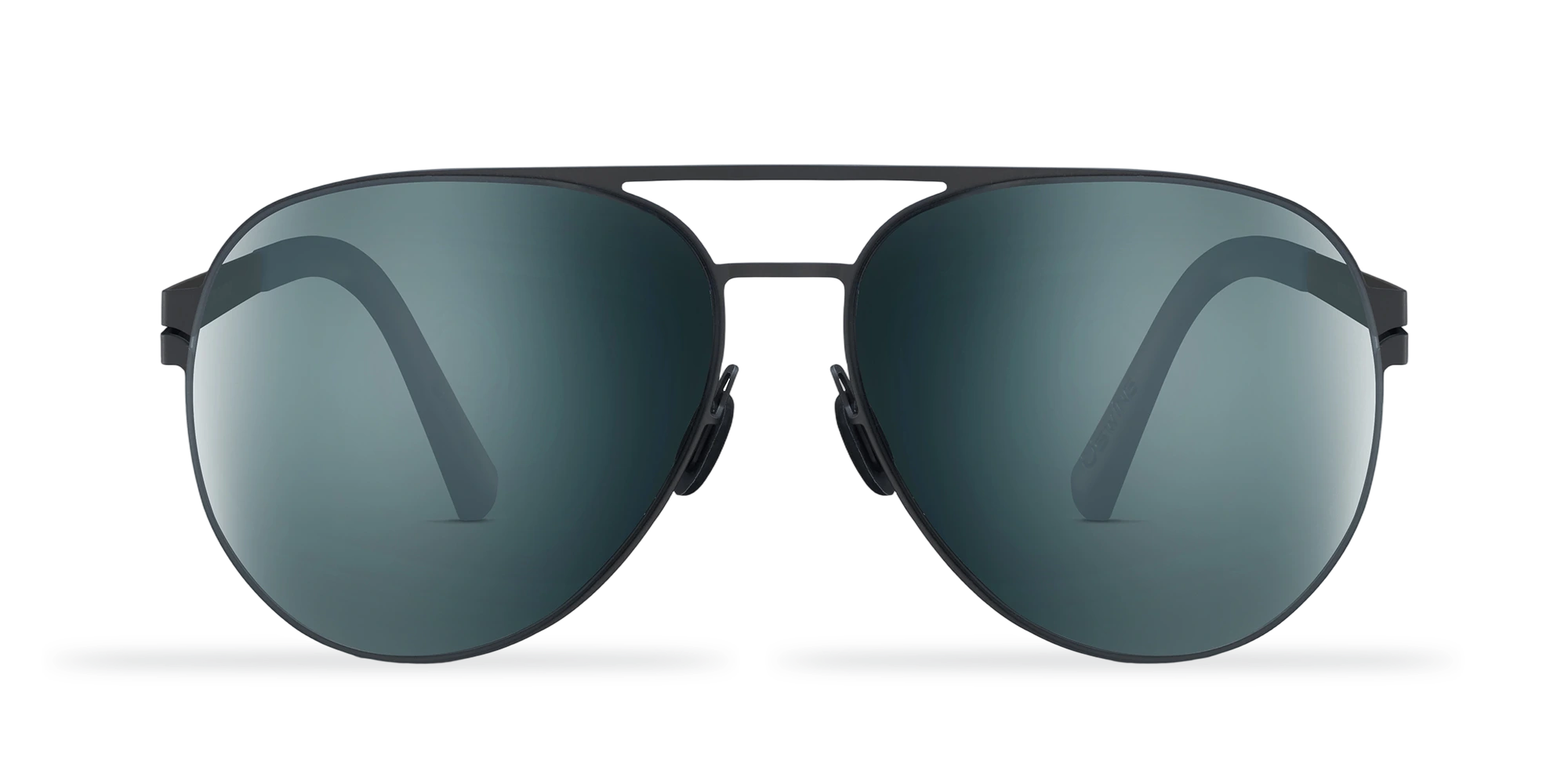
The tested USWING C.T.PAN COL. BLK/C6 configuration gives us a concrete example. Its February 2026 inspection recorded:
Right lens · left: 30.45%
Both lenses
Right lens · left: 0.42%
Together, these figures describe a lens that reduces incoming visible light, transmits very little solar-weighted UVA and shows low measured scatter. Each number tells a different part of the story.
02 / Understand the light
Choose a tint for the conditions. Check UV protection separately.
Visible-light transmittance, or VLT, tells you how much visible light passes through a lens, weighted for daytime vision. At around 31% VLT, the tested lenses let through roughly three-tenths of that light. This is the measurement behind their tint darkness.
How much visible light gets through?
This pair is category 2, within the report’s VLT interval of greater than 18% and up to 43%. Categories help you compare light transmission and choose for the conditions. A higher category means a darker filter, not automatically a better lens.
UV filtering: protection beyond what you can see.
UV sits outside the visible spectrum, so lens darkness cannot tell you how much UV gets through. That is why a separate UV measurement matters. The tested USWING pair recorded very low solar UVA and UVB transmission:
| Measurement | Right lens | Left lens |
|---|---|---|
| Solar UVA transmittance | 0.01% | 0.01% |
| Solar UVB transmittance | 0.00% | 0.02% |
| Between-lens VLT difference | 1.74% relative difference Within the report’s ≤15% limit |
|
Both lenses also transmitted closely matched amounts of visible light. That consistency is another useful quality check when considering a pair of sunglasses.
UV figures are solar-weighted measurements. The reported 0.00% is rounded to the stated precision; it does not mean absolute zero. These results do not establish a measured 400 nm cut-off.
Blue light and polarisation, explained.
Blue light is part of visible light, so it needs its own assessment. UV results cannot be converted into a blue-light blocking percentage. This sample’s report does not provide a tested blue-light filtering percentage.
USWING describes its golf lenses as non-polarised. Polarisation is a separate way of controlling certain reflected light; it is not the same as tint darkness or UV filtering. When choosing eyewear, consider those properties individually.
03 / The detail in the view
Clarity begins with optical precision.
On the course, your view carries information: grass texture, the edge of a shadow, the outline of a distant target. Alongside light transmission, lens quality depends on controlling scatter and unwanted optical power.
Low haze. Less light scattered within the lens.
Haze measures light scattered by a lens under specified test conditions. The C.T. Pan sample recorded 0.40% and 0.42%, both below the report’s 3% limit. Low measured haze is a meaningful indicator of optical quality because it describes how little light was scattered in this test.
Near-zero power for a non-prescription lens.
A non-prescription sunglass lens is designed to manage light without adding a prescription. In this sample, spherical power was 0.01 dioptres in each lens, and cylindrical power was 0.01 D and 0.00 D. These values were close to zero and within the reported limits.
| Measurement | Right lens | Left lens |
|---|---|---|
| Haze / scattered light | 0.40% | 0.42% |
| Spherical power | 0.01 D | 0.01 D |
| Cylindrical power | 0.01 D | 0.00 D |
| Spherical-power difference | 0.00 D for the pair | |
| Horizontal prism difference | 0.08 cm/m, base out | |
| Vertical prism difference | 0.10 cm/m | |
A dioptre (D) measures focusing power. Prism describes displacement of the view. The small horizontal and vertical prism differences were within their respective limits of 1.00 and 0.25 cm/m. The spherical- and cylindrical-power limits were ±0.12 D and ≤0.12 D.
What this means for golf: USWING’s tested lenses combine controlled light transmission with low scatter and small optical errors. Those are concrete lens-quality credentials. Reading a green or judging a slope still depends on the golfer; these laboratory tests do not measure strokes saved or putting accuracy.
04 / Made to be worn
Quality that goes beyond the tint.
Eyewear has to do more than look good on a product page. It is handled, folded and worn against the skin. The inspection assessed the tested eyewear’s response to mechanical stress, perspiration and irradiation, alongside its optical properties.
Frame resilience
Permanent deformation after the fatigue test was 0.30 mm, against a 5 mm limit, with no cracks or breakage recorded. In the bridge test, deformation was 1.35%, within the ±2% criterion, with no lens release.
Perspiration resistance
The specified 8-hour and 24-hour checks passed, including checks for corrosion, discolouration and deterioration or peeling of skin-contact coatings—a relevant part of assessing eyewear worn during outdoor activity.
Tint stability
After the specified irradiation test, visible-light transmission changed by just +0.13% right and −0.03% left, expressed as relative change. Both were within the ±8% criterion.
Lens integrity
The level 1 impact test passed without lens fracture. The coating-adhesion check passed with no detachment. These results describe resistance under the specified test conditions.
Test passes do not predict a number of years of use. Higher impact levels and abrasion resistance were not assessed; the glasses are not established by these results as protection against a golf-ball strike.
05 / Put the knowledge to work
Find the right lens. Then find your fit.
Start with the light you expect to play in. Then consider frame fit, coverage and whether you need a prescription. Those choices make the technical details useful.
Inside the tested C.T. Pan configuration.
Lens material
Uniformly tinted polycarbonate (PC)
Frame
Full-rim stainless steel
Nominal lens width
59 mm
Bridge width
16 mm
Temple length
140 mm
Tested filter category
Category 2
The marking 59□16–140 gives you a practical starting point for comparing sizes. Check how the frame sits on your nose, how the temples feel and whether the lenses cover your view comfortably when you take your address position.
Choose for your actual round.
For bright conditions, check the lens’s filter category and UV information. For overcast conditions or prescription needs, look at the specifications for that exact option. A different tint or prescription configuration can have different optical characteristics.
A note for low light: the tested category 2 sample carries a warning against driving and walking in dim light. Follow the use instructions for your chosen lens, including when conditions change.
With the right specifications in hand, you can choose eyewear for its light management, optical quality and fit—qualities that matter every time you put it on.
Explore the C.T. Pan Signature Series →06 / Confidence in the detail
Know what sits behind the numbers.
The 2026 inspection assessed the identified C.T. Pan sample against GB 39552.1–2020, using GB/T 39552.2–2020 test methods. It concluded that the applicable tested items met the stated requirements. Four pairs were submitted; most individual tests used one pair.
A separate optical test from 2024.
A supplier-held test analysed on 14 May 2024 assessed a different, uniformly tinted green-lens sample against the transmittance requirements cited as AS/NZS 1067:2016, sections 5.2 and 5.3. Its anonymous summary is shown below, separately from the 2026 results.
| Measurement | Left lens | Right lens |
|---|---|---|
| Visible-light transmittance | 28.4% | 30.0% |
| Filter category | 2 | 2 |
| Solar UVA transmittance 315–400 nm |
0.000 (fraction) |
0.000 (fraction) |
| Solar UVB transmittance 280–315 nm |
0.000 (fraction) |
0.000 (fraction) |
The UV entries retain the record’s three-decimal fractional format; rounded zero does not mean absolute zero. This separate sample is not a specification for the current retail range. Its record also warns against driving in twilight, at night or under dull light conditions.
Our approach is simple: explain the property, show the measurement and identify the sample. It gives you a more informed way to understand USWING eyewear and choose the pair that fits your game.